Saturday, December 23, 2017

The Fifth Queen, Ford Madox Ford

I bogged in "The Benefactor" (FMF's chronologically previous work) and skipped ahead to "Fifth Queen," hoping for the Tudor version of Tietjens. Ford's Henry VIII does bear a physical resemblance (heavy, slow-moving, with immense personal dignity and a sense of tragic disillusionment), but misses Teitjens' facile brilliance and principled integrity.

The real focus of the book is Katharine Howard (FMF's spelling of her name), the future fifth wife of the king. It is a highly romanticized view of her, which has more in common with Valentine Wannop in "Parade's End" than actual history, but she's a spunky, passionate, interesting character to follow. For Ford, being able to correct mistakes in Latin on the fly is one of a woman's sexiest qualities!

Where the book succeeds is in creating an atmosphere of dread and Machiavellian intrigue. It's also worth reading for the unique (in my experience) style and language - 1540 mediated through 1905 (roughly). Where else are you likely to run across the word "goosetherumfoodle" in a line of dialogue? There are fascinating, tricky characters, like Lady Mary (the future Queen Mary), and a lady in waiting nicknamed "The Magpie," or the evil but persuasive Throckmorton, and the king himself, who moves through this world with ultimate power and yet seems hopeless thwarted and heart-sick.

One of the things Ford does very well is indirection: a character will demand an answer to a question and not receive it for pages, or in such an ambiguous fashion it creates more questions. It makes the scenes and exchanges of dialogue more intense, but does add to the meandering quality of the book - it's rarely clear to me what Ford's characters want or where the plot is headed. I adore the (brilliant) winding, chronologically nonlinear zig-zag of "Parade's End," but in this novel where the narrative is straight-forward the wandering bothered me.

But one wades through Ford's archaic language and seemingly-directionless plot because there are moments of such psychological astuteness.

"Being young, she felt that God and the saints alike fought on her side."

And in a line that feels especially resonant in the wake of Harvey Weinstein and #MeToo:
"Nevertheless, she made no comment. For she knew that it is the nature of men calmly to ask hateful sacrifices of women. But her throat ached with rage."

There is a stunning conversation between Throckmorton and Katharine in which he accuses her of looking at the world as black and white where it is grey - this is not the days of Plutarch that she venerates in which right and wrong seem so clearly delineated - and then he suggests that even this is a mistaken impression - the world has always been grey and no man, or woman, is completely good or evil.

Saturday, December 16, 2017

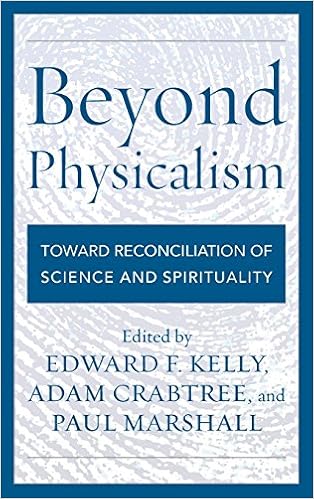
Beyond Physicalism, Edward F. Kelly, Adam Crabtree, Paul Marshall (Eds.)

Beyond Physicalism is the companion book that follows Irreducible Mind. Both are massive collections of jargon-heavy, scholarly essays that map out the fringes of the science and philosophy of mind and then survey various attempts to provide the outlines of a Grand Unified Theory for it.

Kelly writes in the opening chapter: "Our a priori commitment to conventional physicalist accounts of the mind has rendered us systematically incapable of dealing adequately with the mind's most central properties. We need to rethink that commitment." He draws comparisons with the field of classical physics, which had to be substantially rethought to make room for the more fundamental realities of quantum mechanics.

One of the things I like very much about these essays is that they show that the word 'science' describes a method, not a subject. These are intellectually serious people grappling with outlying data rather than dismissing it as 'impossible' and therefore not worth study.

The fringes interest me. I also find, from what previously I've read, physicalist accounts (perhaps I should say 'attempts to account') for consciousness deeply unconvincing. Personally, I lean toward what Beyond Physicalism describes as panentheism, and a view expressed, rather poetically, by Williams James in his last published essay:
. . . we with our lives are like islands in the sea, or like trees in the forest. The maple and pine may whisper to each other with their leaves . . . But the trees also commingle their roots in the darkness underground, and the islands also hang together through the ocean's bottom. Just so there is a continuum of cosmic consciousness, against which our individuality builds but accidental fences . . .

Saturday, November 11, 2017

Omega to Alpha: Love with the Perfect Robot, Cai Marshall & Tom Cayler

I'm a sucker for robot stories, particularly the--what would you call it, coming of age?--variety where they contemplate and evolve. Probably the lingering remnants of my philosophy background. This was a fun read about a spunky search-and-rescue robot who gets loose and doesn't want to go back to the lab and the violence-driven scientist who built her.

The concept is there, and the chapter endings have punch that keeps the story moving. I feel like it needed to travel--more locations--one of the things I learned from George Lucas. And the end felt a bit abrupt to me because it doesn't resolve the robot's situation and doesn't give you a final scene to the romance: we know he's there, but she's--how will she react?

There are two particular issues that interest me about robots-on-the-loose stories:

The first is the need for secrecy: People can't know this is a robot. It's a problem of integration, in a way, and not unique to robots (monsters like Frankenstein, aliens like E.T., occasionally superheroes). There's a strong sense throughout that if people knew this 'other' was among them they would capture/study/weaponize/kill it. But how does anything conscious function satisfactorily in isolation or perpetually in disguise? So that's one problem for the story like this to tackle.

The second is the Pinocchio problem: Does the 'other' try to become human? How well does it succeed? Can it succeed? More interestingly, should it?

Saturday, November 4, 2017

Brain Dead, Ellen Dreyer

This is a mystery that grew on me and I ended up really enjoying it. I loved Timmie and Murphy, who are smart, fast-talking, joke cracking can-do people who reminded me of Julia Spencer-Fleming's Clare and Russ, even though the romance ends up being secondary to the main story. Dreyer has a background (if I remember correctly) as an ER trauma nurse, and the novel is chock-full of medical thriller detail. The complexity of the main relationships, particularly between Timmie and her aging father with Alzheimer's, was handled with deep insight and sensitivity. I also thought it was brilliant that Timmie (an alcoholic's daughter) and Murphy (a recovering alcoholic himself) walk a fine line: attracted to one another, but wary, and with good cause, of getting involved.

Transience, Stevan Mena

A dying detective tracks a serial killer following a series of clues from a 9-year-old girl who seems to be remembering a past life in which she was murdered. Really enjoyed this. There were several well-placed red herrings and I was surprised by the reveal of the killer. I thought the ending was fantastic. Mena's previous work has been in film, but I hope he'll write more. I've added him to my Amazon Author follow list.

The Forgetting Time, Sharon Guskin


Absolutely searing. That's not a word I use frequently, but the emotion here is SO intense. I've been comparison reading along with the new mystery I'm writing: the topic of reincarnation and children remembering past lives is one that has intrigued me since reading Ian Stevenson and Jim Tucker (whom Guskin quotes throughout the book), and I loved how Guskin handles the concept here. The mystery is secondary to the human drama, but all the characters were handled with such sensitivity--well worth reading.

A Watery Grave, Joan Druett


Read this recently for a mystery book club - I thought the premise was brilliant: the protagonist is a half-Maori, half-American linguist named Wiki Coffin aboard an 1836 exploratory mission, trying to solve a series of murders. This is the first in the series.

I loved the setting and concept. Most of Druett's previous work is history, and I felt the book still bore the stamp, which is great if you're into the historical details, but occasionally felt disconnected from the plot. What didn't work for me in the end, besides this question of balance, was that the 'detective' figures out the key to unraveling the initial murder after his side-kick (but in time to rescue him, although the rescue itself was exciting).