Saturday, November 12, 2016


November 8, 2016 feels like it needs its own marker.

Unitarian minister Theodore Parker wrote in 1853:

I do not pretend to understand the moral universe, the arc is a long one, my eye reaches but little ways. I cannot calculate the curve and complete the figure by the experience of sight; I can divine it by conscience. But from what I see I am sure it bends towards justice.

http://quoteinvestigator.com/2012/11/15/arc-of-universe/

Martin Luther King Jr. more famously summarized Parker's thought as “the arc of the moral universe is long, but it bends toward justice.”

It is also worth rereading King's "I Have a Dream" in its entirety:
I Have a Dream


Wednesday, November 2, 2016

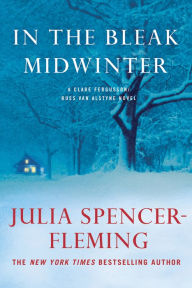
In the Bleak Midwinter, Julia Spencer-Fleming

B & N link
This is the first in Spencer-Fleming's Clare Fergusson & Russ Van Alstyne murder mystery series set in rural New York state. Clare is an Episcopal priest with a background as an Army helicopter pilot. Russ is the local Chief of Police, also with a military background. What she's captured brilliantly is that both positions (minister and detective) are 'set apart': helping professions in which the real people can easily disappear behind the job title.

I was initially dubious. The first chapters felt sensational (abandoned baby, dead teenage girl, incest!) and forced - characters conveniently volunteer and inquire into each other's backstories - but I got sucked in halfway through, and absolutely hooked by about 2/3rd to 3/4. That's a long way to go before getting bitten by the bug, but it does make you reach right away for the next book in the series! I believe there are 8 books out currently.

Spencer-Fleming has a terrific eye for detail, sounds, and smells, that make the world of the book feel real, but I think her outstanding quality is the way she writes in scenes of non-physical intimacy that powerfully bind her characters together: cooking dinner, shared humor, trading stories and hobbies; just knowing there's someone you can be yourself around, who will come looking for you when you are lost.

Nickel and Dimed, Barbara Ehrenreich

B & N link
The full title is "Nickel and Dimed: On (Not) Getting By in America." It should be required reading in college. Or high school. Ehrenreich, a journalist, describes in three sections her experiences as a waitress, as a maid, and a retail clerk, plus other assorted jobs along the way as she attempts to live within her earnings. This is seriously a case of walking a mile in someone else's shoes....

Even though the book is getting dated (2001), it's a snapshot of what it's like to work in a minimum wage job and try to survive. It was an eye-opener to me to realize one of the huge problems is rent. Some of the people she meets are caught living in low-end weekly rate motel rooms because they can't set aside enough to be able to pay a first month's deposit on an apartment that would be cheaper in the long run. Others solve the problem by sharing single-sized living space with other people. Some live out of their cars.

These are not people who are poor because they are unemployed. Many have a job, one and a half or even two full-time jobs. Working poverty, as Ehrenreich shows in her own experience and through the people she meets and informally interviews, is not just a case of belt-tightening, but life in a state of crisis. If you care at all about issues of social justice, you need to read this book or one like it.

Sunday, October 30, 2016

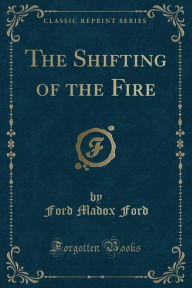
The Shifting of the Fire, Ford Madox Ford

B & N link
This is an early (1892) Ford Madox Ford novel, which has been undeservedly forgotten. Yes, there are some strange bits (the crows) and some overly stagey-Gothic bits, but there is so much good here that shouldn't be rushed by. Ford, like Woolf, has a keen awareness of subjectivity: the compressed/dilated experience of time, the gap between the interior and exterior in conversation.

The premise of the book is a mercenary marriage a young woman (Edith) makes to an elderly millionaire when her fiance (Clem) suddenly loses his fortunes. What makes the story fascinating, I think, is Ford handling of it, starting with a rather extraordinary paragraph about the realities of poverty that keeps the reader from sliding into conventional moralizing.

He concludes:
"If you are sentimental you will shudder and feel righteously horror-struck at the turn of affairs, if practical you will say, 'H'm, a very proper arrangement under the circumstances."

Edith herself, when considering her options, justifies her decision as a form of 'earning money' toward her future happiness, and although Ford does not explicitly pursue this, it at least raises the reality that for young women of her class of her time, autonomy is largely beyond reach.

You find here, in early form, an observation repeated in "Parade's End" that the English are, in Ford's view, singularly ill-equipped to deal with passions and life's great events.

And then there are the tiny gems which give depth and dignity to the unremarked, like Clem's maiden aunt:
"I have little doubt that the poor old lady, stiff and starched as she was, cried a little the night before he departed, for the sight of him had caused the return to her mind of an old, sweet sorrow, and she had grown old and feeble, and her frame was ill able to stand even the shadow, falling thus after long years, of a passion that had once moved her in her most occult being."

Even Edith's horrible husband gets his moments of sympathy:
"Delays of any kind were dangerous to Mr. Kasker-Ryves, inasmuch as they forced his thoughts inwards, and he detested his thoughts."

Saturday, October 15, 2016

Crosstalk, Connie Willis - NO SPOILERS

B&N link
This is a recent release, and if you’re like me and pre-ordered the book a million months ago, the last thing you want is for someone to give away the plot (!!!), so I’ll keep my comments general.

Willis consistently creates characters it’s easy to like. She’s particularly good at setting up love triangles in which a smart, beautiful woman is trying to get closer to a charming, perfect, preoccupied Guy A, only to discover through the execution of the plot that it’s the smart, sweet, slightly rumpled Guy B she wants. It’s about moving from love-out-there to partnership; it’s about a woman (anyone, really) turning away from being dazzled by “perfection” to recognizing true worth is a good heart inside a less flashy exterior, which is partly about romance, but also about what we expect of ourselves, and being kind to the less-than-perfect aspects of ourselves. That never gets old for me.

I think, collectively, of Willis’ work as an indictment of superficiality. She has a set of stock characters she shows as silly: people who gossip, helicopter parents, women who date a string of wrong men without knowing why, the Mr. Perfects. To her credit, she often finds a way to add a twist – so in “Bellweather,” the insufferable Flip turns out to be a key to the puzzle. But essentially Willis uses them as obstacles, delays, and for easy comic effect, which is fine, of course. I do think it loses on compassion, because people (or parts of ourselves) driven by the Urgent rather than the Important are fearful and in pain under the surface – so I can moderately enjoy them, but I think her style of comedy works best in her short stories and in her novel-length books I prefer her at her more serious: Passage, Lincoln’s Dreams, Blackout, etc. I love her comedy; I think she is at her best when she grapples with loss and specifically death.

There’s one line – not a spoiler – in Crosstalk that sums up Willis’ style of writing for me: 
Every thought was connected to every other in a tangled maze of memories and cognitive links and associations... 
because I don’t think Willis writes “plot-driven” books, nor are they really “character-driven”…. I think they’re “theme-driven.” She’ll take an idea, like in this case communication, and riff on it – names, images, setting, elements of the plot – in this kind of ever expanding, looping back in on itself and shooting off in new directions style – and by the end you’ve found out a lot of really fascinating tangentially related things and have a sense of having thought more deeply about something important. She often builds these around a question, or a series of related questions, that form the “quest for knowledge” plot that hook me and drive me to keep reading page after page. I ADORE her books. She is the writer who has made me want to write.

Wednesday, September 21, 2016

Open Season, Archer Mayor

B&N link
I've been reading mysteries set in New England and just recently discovered Archer Mayor's books. Open Season, his first, is a terrific procedural, but with more insight and heart than one usually finds in the sub-genre. He has a wonderful description of his development as a cop as seen in his relationship with his gun:

"It also meant carrying a gun--the ultimate symbol of the simple answer to a complex world--and it gave me a chance, every once in a while, to do something "right," which by that time in my life was becoming an elusive quality... [But] most bad guys were usually regular guys with a screw loose--barring a few exceptions.... The gun lost its appeal as I began to rely more on my instincts than on its authority. I came to see if finally as the unreasoning thing it is: the admission of your brain's collapse under panic and impotent rage."

There is also a wonderful description of his mother that concludes with the perfect simile:

"Outwardly, she remained pleasant and good-natured, but I always sensed a tiredness there, as if she'd been asked to smile for the camera just one shot beyond her tolerance."

Most of all, I appreciate his subtle, careful handling of childhood abuse, which is able to convey indirectly. There is a brilliant scene in which he interviews the mother in a dark green living room he likens to an aquarium. It's an unusual image, but the metaphor of being underwater works so well in this context. The way the elderly mother keeps it and herself spotlessly clean while ignoring the incredible ickiness that has gone on in the house. There's a bit where she reaches down a collects a bit of fuzz off the carpet and puts it in the pocket of her cardigan. Completely real.

Wednesday, September 7, 2016

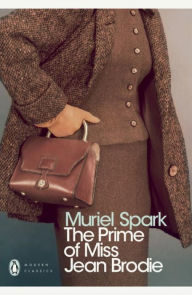
The Prime of Miss Jean Brodie, Muriel Spark

B&N link
I'm a huge fan of non-linear narrative and delayed decoding, and Spark's book is a gem. I love the way she circles around, building the characters through repetition and variation. Even Miss Brodie's speech has this circular quality as she hops from general principles or life lessons to associations or corrections in the present moment. There is an incredible build toward the final, unexpected twist.

I'm looking forward to seeing the Maggie Smith movie, but I'm very glad I read the book first. Absolutely brilliant.

There are delightfully clever lines, like the description of Miss Brodie's nemesis, Miss Mackay, "a sharp-minded woman, who smelt her prey very near and yet saw it very far." And I adore Sandy's imaginary conversations with literary figures, especially her exchange as Miss Brodie recites Tennyson's The Lady of Shallot, which is priceless:

     Down she came and found a boat
     Beneath a willow left afloat,
     And round about the prows she wrote
     The Lady of Shalott.

     "By what means did your Ladyship write these words?" Sandy enquired in her mind with her lips shut tight.
     "There was a pot of white paint and brush which happened to be standing upon the grassy verge," replied the Lady of Shalott graciously. "It was left there no doubt by some heedless member of the Unemployed."